Showing posts with label gratitude. Show all posts
January 10, 2018
Spread the Love
When I volunteer in prison, it includes both group and individual sessions. The pastorals are rich, meaningful, and sometimes difficult. The stories I hear—real stories from real people—are heartbreaking. I try to be a mirror for the inmates. I let them know where they’ve grown and changed and how their meditation practice inspires me. I look them in the eyes and speak this from my heart. Almost always, it brings an inmate to tears, even the biggest, toughest guys. Seeing his own goodness reflected back at him is a revelation. Rarely is he told the ways he’s good, wise, and inspiring.
Like these inmates, I need my own mirrors: friends who support me when I’m caught in fear or doubt. People who reflect back to me the big leaps I’ve taken, the lives I’ve impacted, and the special qualities of my work. Like many, I judge myself most harshly, so it’s helpful when others send a softer, more truthful message. A reality check, not from an effusive place but from a heartfelt place.
We can all look more closely at the people in our lives. They have goodness and light inside them. It radiates in different (sometimes surprising) ways, but it’s there in everyone. What is this person’s special quality? What do I really appreciate about him? How does her unique light shine? These are things we can share with each other. Our lives are wondrous, short, and precious. There’s no reason to hold back: Tell people why and how you love them; spread gratitude and appreciation; share from an open heart.
[This post is part of my Truth Tuesday series, which appears weekly on Facebook.]
---
Welcome Page (start here) | Courses | Monthly Mindfulness | Self-Care | Facebook
November 21, 2017
This Precious Life
[This is part of my Truth Tuesday series, which you can find each week on Facebook.]
An outline of my Mondays in prison: three 30-minute visits (“pastorals”) with individuals, lunch break, 90-minute meditation group, then drive from Oshkosh to Fond du lac for three pastorals at a different correctional facility. It’s a long, meaningful day.
Yesterday after group session, R looked me in the eyes and said, “Joy, you seemed sad today. Is everything okay?” I smiled with gratitude about his care and concern, but assured him I was fine. When I got in the car at day’s end, I cried and cried. R's intuition was correct: sadness. I’m sad for T, who expressed he has no safe space in prison to really feel what he feels—to feel the vulnerability of being abused and being an abuser; to feel helpless yet responsible for changing the horrible language heard among other inmates about women and sexual acts.
I’m sad B has been told his entire life that he’s worthless and never good enough, so that he still questions himself and his beautiful meditation practice. I’m sad that S hasn’t heard anything from her daughter, even though she sent stamped, self-addressed envelopes. And I’m sad that M now mistrusts her beloved brother because he hasn’t sent money (her money) while she’s locked up.
As I sobbed in the parking lot, I realized how much easier it would be to ignore these stories. If I stopped volunteering in prison, I wouldn’t have to face this much suffering and sadness. But those initial thoughts quickly passed, because these aren’t only prison stories—they’re human stories. Life is filled with sadness and pain, just as it’s filled with love and ease. I don’t want to separate myself from life or from others. Instead of “us” and “them,” I believe in “we”: our shared humanity.
I’m inspired that D sees his time in prison as a chance to become more awake, compassionate, and calm. He hopes to counsel recovering addicts when he’s released. I’m touched by heartfelt support I received in my prison meditation group while grieving the loss of a close friend. I’m stunned by the beauty and wisdom L conveys through his poetry.
Life isn’t just one way. It’s many things all at once. Yesterday, I was both sad and grateful, honored to bear witness to inmates. Tomorrow, I travel to Iowa, celebrating Thanksgiving with family and friends. These are not separate events. They’re each part of our diverse, complicated, and beautiful soup of humanity.
May we all bring presence and compassion to more moments.
May we actively practice peace, patience, and love.
May we all be grateful for small, ordinary things.
--
Welcome Page (start here) | Courses | Monthly Mindfulness | Self-Care | Facebook
An outline of my Mondays in prison: three 30-minute visits (“pastorals”) with individuals, lunch break, 90-minute meditation group, then drive from Oshkosh to Fond du lac for three pastorals at a different correctional facility. It’s a long, meaningful day.
Yesterday after group session, R looked me in the eyes and said, “Joy, you seemed sad today. Is everything okay?” I smiled with gratitude about his care and concern, but assured him I was fine. When I got in the car at day’s end, I cried and cried. R's intuition was correct: sadness. I’m sad for T, who expressed he has no safe space in prison to really feel what he feels—to feel the vulnerability of being abused and being an abuser; to feel helpless yet responsible for changing the horrible language heard among other inmates about women and sexual acts.
I’m sad B has been told his entire life that he’s worthless and never good enough, so that he still questions himself and his beautiful meditation practice. I’m sad that S hasn’t heard anything from her daughter, even though she sent stamped, self-addressed envelopes. And I’m sad that M now mistrusts her beloved brother because he hasn’t sent money (her money) while she’s locked up.
As I sobbed in the parking lot, I realized how much easier it would be to ignore these stories. If I stopped volunteering in prison, I wouldn’t have to face this much suffering and sadness. But those initial thoughts quickly passed, because these aren’t only prison stories—they’re human stories. Life is filled with sadness and pain, just as it’s filled with love and ease. I don’t want to separate myself from life or from others. Instead of “us” and “them,” I believe in “we”: our shared humanity.
I’m inspired that D sees his time in prison as a chance to become more awake, compassionate, and calm. He hopes to counsel recovering addicts when he’s released. I’m touched by heartfelt support I received in my prison meditation group while grieving the loss of a close friend. I’m stunned by the beauty and wisdom L conveys through his poetry.
Life isn’t just one way. It’s many things all at once. Yesterday, I was both sad and grateful, honored to bear witness to inmates. Tomorrow, I travel to Iowa, celebrating Thanksgiving with family and friends. These are not separate events. They’re each part of our diverse, complicated, and beautiful soup of humanity.
May we all bring presence and compassion to more moments.
May we actively practice peace, patience, and love.
May we all be grateful for small, ordinary things.
--
Welcome Page (start here) | Courses | Monthly Mindfulness | Self-Care | Facebook
October 24, 2017
Look for the Good
A quick glance at the news tells us what’s wrong with the world: political wars, violent acts, and natural disasters. These are not to be ignored. We live in a complicated world and to make a difference we must face hard truths. But if we focus solely on what's wrong, we become scared, frustrated, and hopeless.
There’s a negativity bias in our brains. We come by this honestly, through evolution. Negative news, which seems to “sell”, feeds directly into fearful, primal parts of our brain. Yet our more evolved brain allows for awareness, discernment, focus, and compassion. And it's important to recognize: where we regularly rest our attention becomes the habit of our mind. Our thoughts reinforce fear or love, greed or generosity, anger or peace.
We can choose to rest in love, generosity, and peace. Not as a way to ignore injustice in the world, but as a way to more skillfully act and contently live. When we look for the good and stay for 3 breaths, embodied, we build new awareness, and we begin to see more good. This brings more ease to daily life and provides renewed hope in the world.
Looking for the good can occur in small, ordinary ways: notice when someone smiles, pause after completing an important task, watch a sunset, accept a compliment, look for kind acts, or feel the sun's warmth on your face. It's okay to pause and take in the good. It's okay to slow down and enjoy life. You can begin right now with this short meditation:
Short Gratitude Pause
Labels:
choices,
gratitude,
kindness,
life,
meditation,
mindfulness,
pause
June 15, 2017
End of the Day
Evening comes. The day is done. If I stay aware, I do something that settles and nourishes. If I'm distracted, I often do something that overstimulates and depletes. (This is a life-long practice.) Either way, I'm met with thoughts as I lie down to bed. When I follow my thoughts in their endless loops, I stay awake. When I transform my thoughts, from blah-blah storylines to heartfelt gratitude, or when I move away from thoughts and gently into my body and breath, I fall asleep. Letting go at day's end is a powerful practice. Letting go of things undone or plans for tomorrow; letting go of tension, bit by bit; letting go of the copious methods we use to control the uncontrollable.Short, regular pauses throughout the day—connecting with body, breath, and awareness—help us rest and sleep more easily. But we don't always remember and life interrupts. Whenever you feel anxious or unsettled at day's end, come here—to this post—and listen:
--
E-Course: Coming Home to Yourself | Monthly Mindfulness | About Joy |
Guided Meditations | Facebook Page | Photography
June 4, 2017
How a Baby Raccoon Saved Me
Late Tuesday night, biking home from a friend’s house, I spotted a furry object on the sidewalk. This surprised me, as most critters flee when a person approaches, but not this one. So I stopped right there and met the eyes of a distressed baby raccoon. He looked at me, mewing and peeping. I spoke in a gentle voice: “What’s going on, little one? What do you need?” He clambered up my bike tire and clung for dear life, peeping in earnest: a direct cry for help; a situation I could not ignore.I called my friend Miriam, whose house I’d just left, knowing she was awake and knowing she has a compassionate heart. Quickly, she researched our options and said she’d be by my side soon with a box and blankets. The raccoon retreated from my bike and laid in the grass. I sat cross-legged next to him, singing a loving-kindness chant. (A chant I’d just taught in my mindfulness class that evening.) He calmed, tucking his face into his fur, cold and scared.
Miriam constructed his evening nest, and we hoped mama would return for him that night. When we stood, about to part ways, still wide-eyed from these events, Miriam spotted a different baby raccoon in the street, recently killed by a car. A sibling of our little friend. It's no surprise he emphatically asked for help: he just witnessed a traumatic death. In life, we don’t often see the backstories of others, but they’re there and they're important, and this particular backstory was clear.
After little sleep, I awoke and readied to teach meditation at the Y, but first needed to check with my raccoon. When I approached the box, his eyes were open. He was alive and okay, but not retrieved by mama, so box and baby came home with me: sat on my back porch while I taught.
I cleared my day to find this little raccoon a refuge, trying to embody the words of Mary Webb: “If you stop to be kind, you must swerve often from your path.” In beautiful weather, I drove to Green Bay, where the Bay Beach wildlife refuge was teeming with kids and adults. I unloaded the box and walked inside. The setting felt strange, like a hotel lobby, people milling around while I attempted to “check in” my animal—a process I expected, somehow, to be more intimate. And in this sea of humanity, I was told, “We only take raccoons from Brown county. We don’t have room for others.” My Outagamie-county puffball was turned away—no room at the inn. Though this was disappointing, I understood the situation. My parting gift: two more numbers to call. The first shelter only accepted squirrels. A sinking feeling spread through me: what if—due to limited resources—I must send this baby back into the wild? I tried to stay present: make the next and last available call.
Sue, from Wildlife of Wisconsin, answered the phone and wanted to hear my story. Where did you find him? She listened with care and compassion. “Yes, we’ll take him. I can meet you at a gas station in Reedsville later this afternoon.” (By the end of this day, I’d drive 3 hours during my “swerve to be kind.”)
Late in the afternoon, on my way to meet Sue, I saw multiple dead animals on the road, including raccoons. I knew I wasn’t “saving” this one—who knows how long he’ll live—but I was answering his call for help; making a small difference. He purred, chattered, and moved around the box. I drove, feeling fear—the uncertainty of life—and also feeling focused and aware. At the gas station, Sue was in the midst of a hectic day and still attended to us with care. She transferred the animal to her car, saying, “We’re only supposed to take 60 raccoons, but I always take more.” I was teary-eyed with gratitude, thanking her both for her work and her kindness. She replied, “We need people like you who really care. Imagine how many people just walk on by.”
I returned to my van and sobbed. Big, heavy sobs of relief, love, gratitude, and grief. (My friend Miriam, who tended this raccoon with me, recently lost her husband—my dear friend—to cancer. This was all interrelated in a raw and powerful way.) Seeing more roadkill on my drive and listening to a dharma talk on death and impermanence, I knew I hadn’t done anything grand. My actions were a small drop in the kindness bucket. I can’t save all raccoons, but I could support this raccoon, who so clearly asked for my help. It seems that's the most important thing we can do: Help the person right in front of us. When someone asks for help—in either a straightforward or hesitant way—we can stop to be kind; we can swerve a little from our path.
When I got home, exhausted and relieved, I walked around my yard. The previous week, I saw only weeds in my flower beds, which reflected the resistance in my grieving heart. But on this evening, I felt joy and wonder. I saw only flowers and abundance. I felt love, gratitude, and happiness. And slowly I realized: I didn’t save that raccoon; He saved me.
--
E-Course: Coming Home to Yourself | Monthly Mindfulness | About Joy |
Guided Meditations | Facebook Page | Photography
May 4, 2017
Lessons from My Garden
Yesterday, I spent two hours in my yard. I made new flower beds last fall, using compost and cardboard. I worked in one bed: digging out dandelions (how do they still exist in no-light conditions?), cleaning grass from edges, and loosening soil. It felt good to place my hands in dirt; to connect with the earth. It also felt good to be outside: to hear birdsong and talk with neighbors.After planting groundcover in the front bed, I walked into the backyard. My intention: obtain an overview of my other garden spaces. But my “overview” turned into a focused mission: get rid of weeds. I was hijacked by some primal part of my brain, and although I was tired, I went to the garage for a trowel and began digging out weeds. Once I started looking, I saw weeds everywhere.
I credit my mindfulness practice with bringing me back—back to patience, perspective, and gratitude. I dropped the trowel, stood up, and walked slowly around the yard. Having released my grip, both literally and figuratively, I felt ease and wonder. I looked at copious plants, in different states of development. I saw possibility: open spaces where I can transplant or plant anew. I felt satisfaction with my careful work in the front bed.
Gardening provides me important life lessons. Here are a few from yesterday:
1. When I focus on weeds, I ignore beautiful flowers. Where I regularly place my attention becomes the habit of my mind. When I cultivate peace, compassion, and generosity, I feel better. When I feed resistance, irritation, and judgment, I feel worse. Sometimes I incorrectly believe there’s no choice: I see only weeds and work angrily to get rid of them. Most times, I recognize the choice: yes, there are weeds—in the ground and in my mind—which I'll never eradicate, but I can be with them differently, and I can also consciously savor the flowers.
2. Everyone has weeds. When I inhabit the small-mind of ego, I take things personally. My thoughts feel real but aren’t true: “My yard is the only one with weeds—it’s a personal failing; I'm the only person who feels shame and inadequacy.” These untrue thoughts isolate me when I most need connection. We all have weeds. We all feel pain. It’s part of our shared humanity. Deep connection comes when we show each other our “weeds” and accept one another as the beautiful, imperfect creatures that we are.
3. Persistent effort is important; patience is even more important. My garden brings me satisfaction, both in short-term effort and long-term results. Still, I get tugged by impatience: I want all the weeds gone now; I want all the planting done now. These are just thoughts. And they aren’t actually true. My true intentions: to enjoy my experience; to feel satisfied but not exhausted; to work, not from fear or anger, but from love and creativity. This requires patience. I need to put in effort, but I also need the gentle reminder that everything takes time.
--
E-Course: Coming Home to Yourself | Monthly Mindfulness | About Joy |
Guided Meditations | Facebook Page | Photography
May 2, 2017
Grief and Gratitude
Four months after mom died, I began my volunteer work in prison. During our mindfulness sessions, we sit in a circle, volunteers and inmates together. We begin with meditation and then check in. The check-in is group meditation: each person shares from the heart while the group listens, in a spacious, deep way.My first few check-ins were raw: the relationship between meditation and grief. I didn’t hold back; I let myself be vulnerable. After everyone shares, there’s time for general discussion. One inmate (I’ll call him “R”) looked right at me and told a story from his previous incarceration.
He went to a parole hearing, not expecting much but received wonderful news: he would be released in a week. He'd be released! R was beyond happy; he was giddy. When he returned to his cell, there stood “white shirts.” (Blue shirts are guards; white shirts are administration.) R immediately thought, “Oh no, something happened and they reversed the decision. I won’t be released.” But that wasn’t the news. The two men in white shirts said, “We’re sorry son, but your mom has died.” This took his breath away. His mom was his best friend. She was the first person he wanted to tell about release. On the very same day, two extremes occurred: he received freedom and his mother lost her life. Through tears, he said—still looking right at me—that for the next week he bounced repeatedly between joy and grief. And this juxtaposition helped him heal. He hoped that I could find the beauty and growth within grief. This was his genuine wish for me.
The whole group silently bore witness to this exchange. Both me and R in tears. Vulnerable, brave, raw, and real. A group wish for growth and healing within pain. A wish for insight within grief.
Only now, a year later, do I fully understand R’s words. I understand how sadness and gratitude exist in the same space of my heart. To love fully means to grieve fully. Once the heaviness lifts, there’s spaciousness, gratitude, and even joy. When I'm tugged by heaviness, I allow for tears—for sadness—yet I also allow for ease and gratitude. I smile as I think of mom (and Patrick and Mary and Grandma). I’m deeply grateful they were in my life; that I knew and loved them for even a short time.
I’m equally grateful for the compassion, wisdom, and vulnerability I witness in prison. In an institution that actively de-humanizes people, I observe humanity and caring in unique and beautiful ways. Greg Boyle writes, “Compassion is not a relationship between healer and the wounded. It’s a covenant between equals.” My prison sangha is just that. And this would make my mom smile.
--
E-Course: Coming Home to Yourself | Monthly Mindfulness | About Joy |
Guided Meditations | Facebook Page | Photography
November 23, 2016
Vulnerability and Gratitude
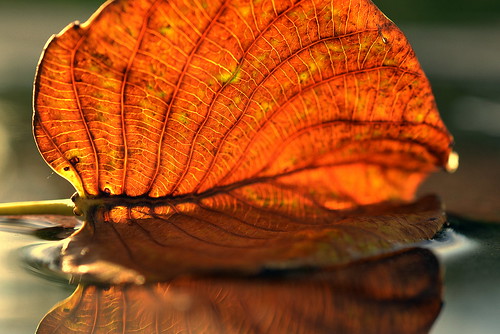
Like this leaf, I feel simultaneously delicate and bold; blurry and focused; vulnerable and brave. Honoring darkness yet reaching for light: looking for the good in myself, others, and the world.
In the States, it’s Thanksgiving week, which is a natural time to reflect: What’s good in our lives? For what are we grateful? It's a time to make food, share stories, listen, and commune. But can I thrive in community while feeling delicate, blurry, and vulnerable? (Reminder to self: I equally feel bold, focused, and brave.) I think there's strength in bringing vulnerability to community. I hope to show up, as is, with an open, grateful heart.
Each day, I'm inspired by all the good in the world. Inspired not in a Pollyanna-ish way, but in a real way. There's goodness when people cry and hold hands, or when they laugh and dance. There's goodness in nature, everywhere, when we see with fresh eyes.
I'm grateful for sunsets, hugs, postal mail, kindness, meditation, friendship, bird song, kale, coffee, photography, and laughter, especially from children. I'm grateful for love and support from people near and far (you're included in this gratitude: thank you!). Please join me: For what are you grateful—big, small, or in between? Let's allow gratitude to spill forth into this complicated, wondrous, uncertain, and beautiful world.
--
E-Course: Coming Home to Yourself | Monthly Mindfulness | Guided Meditations
November 3, 2016
Awakening Joy
The poet Hafez wrote about "Tripping Over Joy." He describes the difference between an enlightened person and us ordinary humans: "The saint is now continually tripping over joy and bursting out in laughter saying, 'I surrender!' Whereas, my dear, I am afraid you still think you have a thousand serious moves."
In my experience, joy is not something to conjure up or create. Joy arrives when I'm present, embodied, and aware. It arrives in the spaciousness of an open heart. And it shuts off when I think of my "thousand serious moves." Life is often far more simple than I make it. Over-complicating things—taking myself too seriously—is a method of protection and control. Though I know it's impossible, I want to control life: I want people not to die or suffer. Interestingly, grief can awaken joy. When I allow my heart to crack open with sadness, I allow it to crack open with wonder. I just need the reminder: Surrender control. Pay attention, with a loving heart. Let life flow. Be real, raw, and true.
When I remember and begin again, joy always finds me. It surprises me in beautiful ways—ways that are not grand or extraordinary. Everyday moments can be filled with wonder.
--
Monthly Mindfulness | Guided Meditations | Facebook Page | Photography
September 12, 2016
Gratitude Surprise
In research studies, gratitude is strongly and consistently associated with greater happiness. If we reflect on what's good in our lives, we start to look for and see goodness in others, ourselves, and the world. Though I've practiced gratitude in different ways, there's one practice I resisted: choose a gratitude buddy and share every day. I resisted for varied and unimportant reasons: I wasn't sure who to ask; I was leery of creating another to-do; it felt forced. But one morning I realized a gratitude buddy might be good medicine. Especially now, in my current circumstances, which are difficult, heartbreaking, and raw, as well as beautiful and life-affirming.
I called my friend Steph and pitched the idea. She was game. We established guidelines: share gratitude daily via text; no expectation of response; try it for a month. We've been doing this for a mere two weeks and I notice a positive change. Two things surprised me: 1) having a gratitude buddy keeps me accountable (though I imagine myself practicing gratitude each day, that's not reality—having Steph on the other end keeps me focused on this practice); and 2) each day, I receive a message about something good in Steph's life—I enjoy the receiving as much as the sending.
Some days I hear the text-message sound and think, "What now? Who needs me?" or "What's wrong?" It's a wonderful re-frame to open my phone and see a simple message from Steph, sharing something positive about her life. Likewise, it's helpful for me to get off autopilot and send a text with intention, care, and gratitude.
As with all practices, the process is personal—what works for me might not work for you. But I know this: I resisted for a long while something that now brings me ordinary and profound joy, and this feels worthy of sharing. I'm grateful to be in this world with so many wise, interesting, and beautiful people. Thanks for being you!
--
Guided Meditations|Everyday Mindfulness|Photography|Facebook Page
Labels:
connection,
gratitude,
intention,
life,
mindfulness,
pause,
sharing,
wholeness
August 14, 2016
Embodied Gratitude
Before bed, as I reflect on the day, my mind wanders to the negative: undone tasks, mistakes made, or ways to improve. These thoughts aren't personal to me, they're habit of the human mind. Our brains have a negativity bias. This fearful view is helpful for immediate survival, but it's detrimental to long-term health, well-being, and connection. The good news is we can tilt our brains back toward the positive. And we can do so with small, intentional steps.
Gratitude is an empowering, positive practice. It's even more powerful when we embody the experience: move it from positive thinking to deeper awareness in the body. With regular 3-breath pauses—taking in the good—we re-train our brains. We shift our outlook: instead of fear, we see hope.
Like anything, it's helpful to actively practice rather than just read or study. I created this short video, so we can practice together:
Guided Meditations|Everyday Mindfulness|Photography|Facebook Page
May 9, 2016
Embrace the "Mother" in You
Mother’s Day is a big deal in our culture. Brunch, gifts, cards, flowers. I’m glad mothers are honored; the celebration is important. (I remember you, Mom, with love and gratitude.) I also feel there are many ways to be a “mother”:
Tend a garden. Mentor a child. Give a hug. Stay, even when—especially when—it’s difficult. Smile at strangers. Carry snacks. Listen with attention and care. Love generously. Show compassion. Be strong when needed and vulnerable when needed. Sing gently. Dance freely. Live, laugh, and cry from an abundant heart.
Imagine if we all embraced these pieces of mother within us. If we did, I think the world would change in amazing, radical, and beautiful ways.
Guided Meditations|Everyday Mindfulness|Photography|Facebook Page
November 24, 2015
Giving Thanks
It's easy to rush through life, but the pauses connect us. When I pause, the quality of my heart shifts. There's time to be kind; to share a genuine thank-you or provide comfort. And there's space to be grateful. I'm grateful for big things, like a safe environment and loving friends. I’m equally grateful for little things: rays of sunshine, fresh spinach at the market, or an elongated hug.
Gratitude is a current research topic. The studies show that gratitude practice is consistently and strongly associated with happiness. There’s so much beauty and kindness in this world. It’s easy to forget, but we can remember. For what are we grateful? What small moments have changed our days and our lives? How do we give thanks?
--
March 16, 2015
A Meaningful Thank You
Based on this experience, I formed a new practice: look service people in the eye; really see them and genuinely thank them. It takes mere seconds, yet generates gratitude and well-being. When I pause to give a genuine thank-you, I pause to see and appreciate my life.
This process naturally extends to co-workers, neighbors, friends, and loved ones. We often say "thank you," but not in a meaningful way. The words are rushed or mumbled or automatic. Yet we can turn thank-yous into mindfulness practice. Each thank-you is a deep pause--a time to re-connect with ourselves and each other. This happens when we make space in our hearts and minds; space to feel the gratitude and to share the gratitude. It requires very little time, yet that time is meaningful. The thank-you lingers in a beautiful way.
April 9, 2014
Always Share the Happy Thoughts
Imagine you're having a conversation with a friend. And the discussion leads to an insight about another person--a kind act you witnessed, a positive change you noticed, a brave step you saw. It's easy to gloss over this experience, because that particular person isn't with you. Yet this happy thought is worth sharing. What if we remembered these happy thoughts--maybe wrote them down. And then made a point to share that positive moment with the other person (e.g., spouse, child, coworker, or friend).
We often protect our hearts from hurt. Interestingly, not sharing the good thoughts is a form of protection. What if I tell this person the positive change I noticed and he thinks I'm weird or she makes fun of my pollyannaish-ness? I'd like to share the good with this person, but that's just not how our relationship works. These are all forms of protection. Yet they also shield our hearts from gratitude and love. They constrict rather than expand.
Given the uncertainty of life, it's important to tell people what they mean to us. It's important to share the happy thoughts, listen to the difficult, and treat ourselves and others with kindness. There's no need to hold back the joy, love, and gratitude. If you realize something good about another--even the smallest thing--share it. Tell them. Kindness is contagious.
November 25, 2013
Today I Choose Gratitude
Gratitude is good medicine. Years of research shows its positive impact. When grateful, we're happier, healthier, and more resilient. Some days the gratitudes naturally flow. Other days we're clogged. During life's challenging moments, anger and frustration flare. Gratitude might feel like foreign land, but it's only a few breaths away. If we pause and soften the heart (just a little), we can rest in thankfulness (or at least gain perspective).
My cranky-clogs clear more easily when I attend to my gratitude practice. At bedtime my body rests, but my mind often spins. I process the day, working through ideas, counting undone tasks, or replaying conversations. When I observe the spin, I first sink into my body, noticing and deepening my breath. Then I re-focus my thoughts--for what five things am I grateful today? (A stranger smiled back at me. I received a letter in the mail. Mark made me laugh. I noticed my busy mind and paused. My bed is comfortable and cozy.) Small things, big things, it doesn't matter. The practice reconnects me with my grateful heart.
Recently I found another practice: write a letter of gratitude to someone and read it aloud to them (while staying awake to your own and the other person's emotions). This suggestion deeply moved me. In particular, it seemed apt for my mom. Life with mom is complicated, but I easily filled a page with my genuine, heartfelt gratitude toward her. And during this Thanksgiving week, I'll read her the letter. It'll be an interesting part of our journey together--whatever the outcome. [Post-Thanksgiving update: Reading the letter to mom was a surprisingly different experience than just writing the words. My heart opened wide, the tears spilled, and our connection deepened. Mom listened and she smiled. Indeed, this was a wonderful part of our journey.]
The ritual of gratitude is both sacred and basic. It's always within reach. Not as another self-improvement or to-do item. As a buoy during the storms of life and a friendly companion when all is good. Today I choose gratitude. Will you join me?
August 28, 2013
Reclaiming Fall
It's late August, and for the first time in years, I feel an absence of dread. Human behavior is fascinating. While walking the must-be-an-academic path, I regularly made rationalizations: it's okay if I'm exhausted all term, because I get some breaks where I can sleep and maybe create; it's okay if I let autumn slip away, because I must give myself over to my job (and, really, I had a good summer).
No longer in academia, I can build a new relationship with fall; I can let it fully into my heart. The changing leaves, cooler air, tasty apples, garden closing, animals gathering--all of this I can experience completely; no need to hold back.
Teachers have a schedule that aligns with the seasons. I'm not sure of other professions where specific seasons are blocked out--lost in the busyness. (I'm sure they exist.) Sometimes the busyness is so great that all seasons are lost.
Nature grounds me. It provides easy access to the present moment. And the seasonal changes supply awareness practice: what's different today? How exactly is it different? What emotions do I project onto the change?
This year I'm especially grateful to walk beside autumn; to lean into her and see what she's about. And I welcome company along the path.
July 26, 2013
More Thoughts on Compliments
Compliments are on my mind. I've written previously about taking in the good--the tension between accepting the good yet doubting our worthiness. In The Story of You e-course, Jen & Ria posed an interesting question: what kinds of compliments do you readily accept and what compliments do you quickly deflect? This was a revealing exercise for me. And I'm still thinking about it.
In general, I try to graciously accept compliments (regardless of my internal struggle). Kind words are gifts offered by others--gifts I don't want to diminish. And mostly my outward acceptance mimics my internal process. Except for two types of compliments: 1) kind words about something I've done (e.g., food, photo, writing), but I don't feel is my best work; and 2) kind words about something with which I have a complicated relationship.
I know people have different perceptions about the exact same event. We all see things through our particular lens. (Sometimes my lens feels clear and other times it feels cloudy--tainted by my internal stories.) So back to the first compliment type: isn't it possible that someone genuinely enjoys a piece of my work that I don't feel is my best? Of course, it's possible. In fact, it's likely. Yet I doubt the sincerity--I assume the person must be offering a compliment just to be nice. This is a reaction from a place of unworthiness. Re-framing the situation: I can accept the compliment and ask what, in particular, the person likes. Maybe I'll learn something about my own work; something to which I was previously blinded.
I'm a caretaker; a giver of open-hearted love. Connection to other people is an essential part of my life path. But if I'm not careful, my authentic action can morph into must-dos. When I receive a compliment about a care-taking action, I drink it in (for a moment). But then I'm filled with doubt: now I must keep doing this particular action for the rest of my life (or I'm not a good person). Doubt is such a nasty mind state. It casts a strong shadow on our basic goodness--our worthiness, as is. With this second compliment type, perhaps I can just rest in the acknowledgment of my heartfelt work. Just rest there, no future action required.
Oh, compliments. They seem so simple, yet can be complicated. It's interesting for me to view both sides of compliments--to be authentic in giving compliments and to be mindful in receiving them. I think both ends reveal much about our inner-dialogues. Dialogues that include voices we want to nurture and voices it's best we ignore.
July 23, 2013
You Never Know
Black-eyed Susan is my favorite flower. It captured my heart long ago, when I saw masses of its blooms in the wild. Once I chose to garden, I knew what I wanted: a huge patch of black-eyed Susans. I began with transplants from a friend--the bunnies mowed them down. Then I tried native wildflower seeds. For one summer, they blossomed, yet were soon crowded out by the daisies. Last year, I planted more, but they didn't withstand the drought.
As part of my equanimity practice, I decided my yard wasn't long for these expressive flowers. And that's okay. I'd appreciate what I have and admire the black-eyed Susans in other people's yards.
And then, just days ago, I noticed a rogue flower stem among my ground cover. Yes, it was an intrepid black-eyed Susan. Probably around for this summer only, but a wonder nonetheless. Each time I look at it, I'm filled with joy and gratitude. You just never know what might happen.
March 8, 2013
Human Connection
Today is my last official day in the classroom at Lawrence. (I'm here spring term, but on sabbatical--a lovely, low-key way to transition.) This is an emotional day--more emotional than I expected. Not because I doubt my decision; because I deeply care for my students. My interactions with students (in and out of the classroom) are what fill my heart and lift my spirit. I enjoy talking with students about statistics, but enjoy even more talking about life. I see the creativity, strength, and light in all my students. When possible, I try to reflect my view back to them. The stories that play in our own minds are often distorted; the inner-critic wants to squash our light. It's a gift to see ourselves through the eyes of another. In Lawrence students I see kindness, creativity, emotion, intelligence, vulnerability, and light--in a variety of ways.
Recently I wrote some six-word memoirs, concisely summarizing where I am right now. Here's one of my memoirs: achievements fade away; people matter most. Indeed, people matter the most to me. Thanks to the whole Lawrence community for making me feel so connected.
Subscribe to:
Posts (Atom)