Showing posts with label sharing. Show all posts

August 25, 2017

Connect, Listen, and Be Kind


In 2008, I was still (happily) a statistics professor at Lawrence University. During commencement weekend, I gave the baccalaureate address. Just recently, I found my speech, which was never shared on my blog. In general, these words still ring true. So, here's a blast from the past, a view from 10 years ago...

Perhaps some of you have heard of the “six-word memoir” started by SMITH Magazine. SMITH is an online magazine that celebrates storytelling. In 2006, the editors challenged their readers to write six-word memoirs—a short six words to summarize a life. The response was overwhelmingly positive and sometimes deeply personal.  The magazine published a book that includes hundreds of these memoirs. 

Some of the memoirs are humorous, for example: “One tooth, one cavity, life’s cruel.” “The psychic said I’d be richer.” “Where the hell are my keys?” “College was fun. Damn student loans.”  

Others of the memoirs describe life’s difficulties: “Learning disability, MIT. Never give up.” “Hard to write poems from prison.” “Widowed. Forging reluctantly forward with faith.” “Cursed with cancer, blessed with friends.”

This second set of memoirs addresses topics we all encounter but often don’t discuss—difficulty, death, heartbreak, disease, struggle, depression. In not having the discussion, we isolate ourselves during a time when we might desperately need connection. Life is difficult for everyone. If we struggle, it doesn’t mean we personally did something wrong—it just means we’re living life. And it’s through these difficulties that we grow stronger as a people.

In his translated Letters to a Young Poet, Rainer Maria Rilke writes about the transformative, not necessarily negative, effect of sadness: “You have had many sadnesses, large ones, which passed. And you say that even this passing was difficult and upsetting for you. But please, ask yourself whether these large sadnesses haven’t rather gone right through you. Perhaps many things inside you have been transformed; perhaps somewhere, deep inside your being, you have undergone important changes while you were sad.” 


I encourage each of you, within your own comfort zone, to talk about the difficulties and the struggles. To know you aren’t alone. To not compare your difficulties with others. Difficulty is difficulty, and pain is pain. Sylvia Boorstein, a Buddhist teacher and author, talks of an inscription she encountered while on retreat. The words are simple, yet meaningful: “Life is so difficult. How can we be anything but kind?” Let me repeat that: “Life is so difficult. How can we be anything but kind?” Kind to others and kind to ourselves. Just a slight softening during a difficult time. Softening of words, responses, and actions at a time when hardening is often the status quo. This is not to say we should naively ignore inappropriate or damaging behavior by people (ourselves included). But it does say that as a general rule, kindness is helpful. And connection is helpful. Let's have those difficult conversations—both as a sharers and as a listeners.

Some of the other six-word memoirs are about mistakes made and experience gained: “Afraid of everything. Did it anyway.” “Most costly mistakes, learned valuable lessons.” “Happy now that I know myself.” “Learned. Forgot. Better off relearning anyway.”

Another reality of life is that failure, although sobering, is vitally important. Without taking risks, without making mistakes, without occasionally failing, we don’t push our boundaries and gain valuable insight. I know graduation is a time when we celebrate and honor people’s accomplishments, and this is important. But as you think back over your college career, weren’t there failures and mistakes made, and didn’t these make the accomplishments possible and the appreciation of the accomplishments more rich?

As with other difficult things in life, we don’t often talk about failures—we tend to shove them away, perhaps only discussing them years afterward. Yet there's richness in mistakes that can be mined for helpful insights—insights into ourselves, others, and the world. There’s a fine line, though, between learning from our mistakes and wallowing in the negativity of failure. Kindness is again the key. Can we effectively analyze our mistakes through a lens of kindness? Instead of, “Well, I screwed up again,” can we pause and gently ask, “What can I learn from this process?” Additionally, this understanding and non-judgment can be extended to others. We can give others the space to fail and grow and change. What a wonderful gift to give and receive.


Woody Allen once said, “If you’re not failing every now and again, it’s a sign you’re not doing anything very innovative.” Personally and at a societal level, we need innovation and we’re strengthened by creativity. This kind of creativity does not come from a perfect track record. Expect failures, know everyone fails, listen for the lesson or insight, be kind, and move on.

Happiness, passion, and creativity are the themes of others of the six-word memoirs: “I colored outside of the lines.” “Seventy years, few tears, hairy ears.” “Laughing until I pee my pants.” “Found great happiness in insignificant details.” “I live the perfect imperfect life.”

I encourage us all to do what we love. Spend time doing things we’re passionate about—that get our creative juices flowing. A lovely effect of human variability is that happiness and passion come in very different forms for different people. I get really excited talking with students about statistics. [This was back in 2008. Now I find contentment teaching meditation.] Others of you love playing music or making art or being with children or programming computers or reading literature or gardening. These loves might translate into a paying job or they might simply stay as cherished ways to spend free time. 

In his book Earth in Mind, David Orr writes: “The plain fact is that the planet does not need more successful people. But it does desperately need more peacemakers, healers, restorers, storytellers, and lovers of every kind. It needs people who live well in their places. It needs people of moral courage willing to join the fight to make the world habitable and humane. And these qualities have little to do with success as our culture has defined it.” 

The society in which we live typically defines success by traditional achievements and accomplishments—your grades in school, your advanced degrees, the amount of hours you work, the amount of money you make, your career advancement. Certainly, these are indications of hard and often good work, but they aren’t the only definitions of success. Advances in technology allow us to multitask and be in constant contact with others—checking things off our to-do lists and putting more items on the list. At a time when we're connected to the world through email, cell phones, text messaging, etc., we are often disconnected from ourselves—from our creative thoughts and deep emotions. 


It’s important for us all to reconnect with our hearts—how do we want to spend our precious time? Not because we have to or we should or we’re expected to, but because of a strong creative craving from inside us. Sometimes we’re so busy that we don’t even know what we truly want. So we must make some space, some quiet to reconnect and listen to ourselves. This can be difficult in our current society, but it's not impossible. And the more we pause and think and listen and be, the healthier we and our society become.

I challenge us all to redefine what is meant by success. Not to exclude traditional ideas of success, but to add to the definition. Let it also include pursuing our dreams, doing what we love, making and learning from mistakes, talking about difficult experiences, connecting with others, being kind, and really, truly listening. In the words of David Orr, be a storyteller or a healer or a peacemaker. Connect with and support your own inner longing, while also creating space for others to do the same.

So what do you think your six-word memoir is? And is it perhaps different from four years ago? Will it again be different in four more years? We all change—from year to year, and sometimes from moment to moment. I think we should embrace and celebrate these changes (what wonderful evidence of the life process). 

As I wrote this speech, I thought about and created my own six-word memoirs from various stages of my life. For example, “Love koala bears and Andy Gibb.” (In middle school, the number of koala bear stuffed animals I owned was outnumbered only by the number of Andy Gibb posters on my wall. You students probably don’t know of Andy Gibb, but I can tell you he was a dreamy teen idol who wrote wonderfully cheesy pop singles—“shadow dancing, baby you do it right.”)


A six-word memoir for me in college is “Deeply love volleyball, hate intense pressure.” (I went to Indiana on a full volleyball scholarship. My love of the game was challenged by the intense pressures of winning in the Big Ten. I learned a lot from this experience, and I treasure those memories, but it was difficult at times. Difficult, gratifying. and important.)

My early graduate school experience can be described with the memoir, “Very smart people, do I belong?” (Like most graduate students, I'd done very well in college. In graduate school, though, I felt merely average, surrounded by brilliant people. This was humbling for me, but gradually blossomed into an experience in which I learned about myself and my particular strengths. I found successes in applied coursework, creative solutions, and inspired teaching.)

There are many ways I can currently describe my life. One possible six-word memoir is “Most important thing in life? People.” (My relationships with my husband, my family, my friends, my students—these all easily trump the busyness of daily life. The people are why I love my job. You students are a pleasure to work with in so many ways. And my colleagues are equally engaged, generous, and committed. People, relationships, and connections are what I find most valuable—and this includes my relationship with myself.)


This celebratory weekend is a good time to talk with your friends and family about their six-word memoirs—about their experiences, failures, difficulties, and successes. It’s also a time for personal reflection—how have you changed and grown and what is your current six-word memoir? This is a time to share, listen, laugh, and cry. To be fully present for each of these precious moments. 

And, as you proceed with your next steps after Lawrence, I encourage you to 
Stay connected with yourself and others. 
Have difficult conversations. 
Have joyful conversations. 
Pause regularly. 
Listen intently—to yourself and others. 
Take risks. 
Do what you love. 
And be kind.

[Joy's note: Ten years later, relationships are still the most important thing in my life. Some new six-word memoirs for 2017: "Left academia. Found a different calling." "Be brave. Live wholeheartedly. Love well." "Feeling cranky? Get off the computer." "Tell people why you love them." "Sit on the cushion. Find peace."]
---
Welcome Page (start here) | About Joy | Courses | Monthly Mindfulness | Facebook  

May 2, 2017

Grief and Gratitude

return Four months after mom died, I began my volunteer work in prison. During our mindfulness sessions, we sit in a circle, volunteers and inmates together. We begin with meditation and then check in. The check-in is group meditation: each person shares from the heart while the group listens, in a spacious, deep way.

My first few check-ins were raw: the relationship between meditation and grief. I didn’t hold back; I let myself be vulnerable. After everyone shares, there’s time for general discussion. One inmate (I’ll call him “R”) looked right at me and told a story from his previous incarceration.

He went to a parole hearing, not expecting much but received wonderful news: he would be released in a week. He'd be released! R was beyond happy; he was giddy. When he returned to his cell, there stood “white shirts.” (Blue shirts are guards; white shirts are administration.) R immediately thought, “Oh no, something happened and they reversed the decision. I won’t be released.” But that wasn’t the news. The two men in white shirts said, “We’re sorry son, but your mom has died.” This took his breath away. His mom was his best friend. She was the first person he wanted to tell about release. On the very same day, two extremes occurred: he received freedom and his mother lost her life. Through tears, he said—still looking right at me—that for the next week he bounced repeatedly between joy and grief. And this juxtaposition helped him heal. He hoped that I could find the beauty and growth within grief. This was his genuine wish for me.

The whole group silently bore witness to this exchange. Both me and R in tears. Vulnerable, brave, raw, and real. A group wish for growth and healing within pain. A wish for insight within grief.

Only now, a year later, do I fully understand R’s words. I understand how sadness and gratitude exist in the same space of my heart. To love fully means to grieve fully. Once the heaviness lifts, there’s spaciousness, gratitude, and even joy. When I'm tugged by heaviness, I allow for tears—for sadness—yet I also allow for ease and gratitude. I smile as I think of mom (and Patrick and Mary and Grandma). I’m deeply grateful they were in my life; that I knew and loved them for even a short time.

I’m equally grateful for the compassion, wisdom, and vulnerability I witness in prison. In an institution that actively de-humanizes people, I observe humanity and caring in unique and beautiful ways. Greg Boyle writes, “Compassion is not a relationship between healer and the wounded. It’s a covenant between equals.” My prison sangha is just that. And this would make my mom smile.

--
E-Course: Coming Home to Yourself | Monthly Mindfulness | About Joy |
Guided Meditations | Facebook Page | Photography

November 23, 2016

Vulnerability and Gratitude


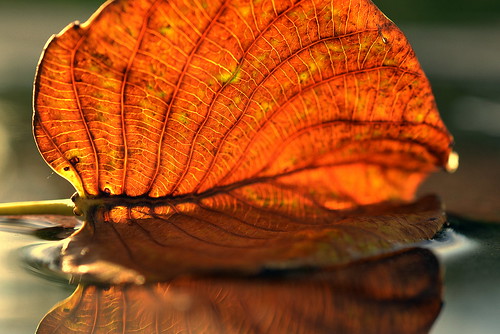
Like this leaf, I feel simultaneously delicate and bold; blurry and focused; vulnerable and brave. Honoring darkness yet reaching for light: looking for the good in myself, others, and the world.

In the States, it’s Thanksgiving week, which is a natural time to reflect: What’s good in our lives? For what are we grateful? It's a time to make food, share stories, listen, and commune. But can I thrive in community while feeling delicate, blurry, and vulnerable? (Reminder to self: I equally feel bold, focused, and brave.) I think there's strength in bringing vulnerability to community. I hope to show up, as is, with an open, grateful heart.

Each day, I'm inspired by all the good in the world. Inspired not in a Pollyanna-ish way, but in a real way. There's goodness when people cry and hold hands, or when they laugh and dance. There's goodness in nature, everywhere, when we see with fresh eyes.

I'm grateful for sunsets, hugs, postal mail, kindness, meditation, friendship, bird song, kale, coffee, photography, and laughter, especially from children. I'm grateful for love and support from people near and far (you're included in this gratitude: thank you!). Please join me: For what are you grateful—big, small, or in between? Let's allow gratitude to spill forth into this complicated, wondrous, uncertain, and beautiful world.
--
E-Course: Coming Home to Yourself | Monthly Mindfulness | Guided Meditations

September 12, 2016

Gratitude Surprise


In research studies, gratitude is strongly and consistently associated with greater happiness. If we reflect on what's good in our lives, we start to look for and see goodness in others, ourselves, and the world. Though I've practiced gratitude in different ways, there's one practice I resisted: choose a gratitude buddy and share every day. I resisted for varied and unimportant reasons: I wasn't sure who to ask; I was leery of creating another to-do; it felt forced. But one morning I realized a gratitude buddy might be good medicine. Especially now, in my current circumstances, which are difficult, heartbreaking, and raw, as well as beautiful and life-affirming. 

I called my friend Steph and pitched the idea. She was game. We established guidelines: share gratitude daily via text; no expectation of response; try it for a month. We've been doing this for a mere two weeks and I notice a positive change. Two things surprised me: 1) having a gratitude buddy keeps me accountable (though I imagine myself practicing gratitude each day, that's not reality—having Steph on the other end keeps me focused on this practice); and 2) each day, I receive a message about something good in Steph's life—I enjoy the receiving as much as the sending.

Some days I hear the text-message sound and think, "What now? Who needs me?" or "What's wrong?" It's a wonderful re-frame to open my phone and see a simple message from Steph, sharing something positive about her life. Likewise, it's helpful for me to get off autopilot and send a text with intention, care, and gratitude.

As with all practices, the process is personal—what works for me might not work for you. But I know this: I resisted for a long while something that now brings me ordinary and profound joy, and this feels worthy of sharing. I'm grateful to be in this world with so many wise, interesting, and beautiful people. Thanks for being you!

--
Guided Meditations|Everyday Mindfulness|Photography|Facebook Page

October 1, 2014

Our Stories


We hold our stories in our bones, in our very existence. Stories of sadness, trauma, and hardship. The telling of these stories is important. Saying the words out loud, unearthing the secrets--these actions honor and empower us. They declare: my life matters.

I've written my stories. I've spoken my stories. I've owned my stories. And now it's time to let go. Freedom came when I told these stories. Prison remains when I live in them. When I think, "I wasn't nurtured enough as a child" or "I felt unseen" or "I sacrificed too much for academia," I enter a box--an identity that no longer fits. Wholeness exists when I nurture, see, and stay true to myself. 

It's an act of kindness to honor my past yet live in the present. I'll continue to tell my stories as they occur. It's how I learn and grow. But the tired stories, they can return to the earth. I don't need them anymore.

April 9, 2014

Always Share the Happy Thoughts


Imagine you're having a conversation with a friend. And the discussion leads to an insight about another person--a kind act you witnessed, a positive change you noticed, a brave step you saw. It's easy to gloss over this experience, because that particular person isn't with you. Yet this happy thought is worth sharing. What if we remembered these happy thoughts--maybe wrote them down. And then made a point to share that positive moment with the other person (e.g., spouse, child, coworker, or friend).

We often protect our hearts from hurt. Interestingly, not sharing the good thoughts is a form of protection. What if I tell this person the positive change I noticed and he thinks I'm weird or she makes fun of my pollyannaish-ness? I'd like to share the good with this person, but that's just not how our relationship works. These are all forms of protection. Yet they also shield our hearts from gratitude and love. They constrict rather than expand.

Given the uncertainty of life, it's important to tell people what they mean to us. It's important to share the happy thoughts, listen to the difficult, and treat ourselves and others with kindness. There's no need to hold back the joy, love, and gratitude. If you realize something good about another--even the smallest thing--share it. Tell them. Kindness is contagious.

December 17, 2013

The Gift of Listening


Think of a time when someone actively, openly listened to you. A time when you told your story unedited and felt heard. That's a powerful experience. Yet how often do we really listen to each other? The barriers to true listening are many: racing thoughts in our minds, our desire to help (read: control) another, and our self-judgment (how do I appear? what does this person think of me?). These barriers can be minor or all-consuming. Regardless, they separate us from the conversation. They separate us from each other.

In this gift-giving season, I challenge us all: give the gift of true listening. Listen to someone without offering unsolicited advice; listen to someone without judgment; listen to someone and really try to understand. Ask questions. Stay connected. Be present. 


Shiny objects steal our attention, especially at lively gatherings. But there's always space. Let's find an opening and listen to one person. Maybe someone with whom we have a difficult relationship. Or someone we've long put in a particular box. Or someone we know really well, yet want to understand in a deeper way. Or someone we know not at all. Maybe it's important to listen to ourselves--turn off the inner-critic and listen to our hearts. 

My intention is to listen more each day. To people. To nature. To myself. I know I'll forget. I know I'll be distracted. Yet active listening is a place I can return over and over again. It's a gift to another and it's a gift to myself.

December 4, 2013

Be Vulnerable (Be Brave)


What does it mean to be brave? The Oxford Dictionary claims it's the readiness to face and endure danger or pain. Certain kinds of bravery are revered in our culture; others are overlooked. I think it's brave to be emotionally vulnerable--to face fear, hurt, shame, disappointment, and grief. To not only face these emotions, but to honor and tend to them.

Yet there are few models of brave vulnerability. Our cultural discourse leans toward judgment and certainty. In response, we create emotional armor. Armor that disconnects us from others. It disconnects us from ourselves. This protection might allow us to face pain, but it's not sustainable for enduring pain. It's not wholly brave.

Before we can be brave, we must understand vulnerability. We must explore our tender places and gradually expose them--in small and safe ways. I think it's brave to declare a dream, share a difficult piece of our story, and lead from our hearts. It's brave to be uncertain and try anyway, to express gratitude and love, and to make purposeful choices (perhaps different from those around us). I think vulnerability is a gift. And as I accept this gift, I become stronger, braver, and more alive.

It's not easy. And it's never complete. We can spend a lifetime noticing and embracing our vulnerabilities. We can spend a lifetime understanding what it means to be brave. A lifetime fully lived and experienced. Sounds like a worthwhile journey.

October 8, 2013

10 More Questions


In May, I answered James Lipton's famous closing questions. Recently, I received a generous comment from Denise Fabian, and she posed 10 more questions. Here are my answers:

1. What pivotal event in your life changed you for the better?
When I was 25, my mom entered a mania. (Although she dutifully took medication, she went toxic on her lithium and was sans bi-polar medication for months.) My family--at that time--didn't speak openly about her illness and its impact on us all. But I chose that moment to have a heart-to-heart conversation with my dad. And that conversation led to weekly lunches, honest expression, and deeper understanding. My dad and I have a very special relationship--I treasure it more than I can put into words. I'm glad I reached out way back then. It scared me, but was one of the best decisions of my life.

2. What type of music do you most enjoy?
I like singer-songwriters. People with interesting voices sharing interesting stories. (Some of my favs: Patty Griffin, Dar Williams, David Francey, and The Wailin' Jennys.)


3. Spring or fall? 
I cannot choose. They are different, yet equally beautiful. Spring brings growth, shades of green, newness, warmth, and rebirth. Fall brings quiet, bright colors, harvest, coolness, and pre-hibernation. All very good things.

4. What is your favorite comfort food?
When I've had a tough day or am especially tired, my favorite cozy distraction is Stuc's pizza and a movie (curled up next to Mark).

5. What is your favorite creative activity?
Photography. It's my flow activity. When I shoot, I'm fully present and alive; I'm mindful. The act of taking photographs calms and centers me.

6. Looking back at your life, what era would you like to live over?
Even if I could go back, I don't want to. I am a collection of experiences and learning. With each year, I love myself more and I love life more. I wouldn't be who I am without the difficult--mistakes, unskillful actions, hurt, disappointment, pain. Right now I'm living life without regrets. There's no need for me to go back.


7. Barefoot or slippers?
I get cold very easily (even when it's 80 degrees outside). If I choose to be barefoot, I'm not cold. So barefoot!

8. How would you describe your home-decoration style?
Colorful, comfortable, warm, simple, welcoming, artful.

9. What evokes emotion in you?
Almost everything. I'm brought to tears by joy, relief, deep sharing, sadness, tragedy, and beauty. I wear my heart on my sleeve. I don't know how else to live.

10. What one thing do you want to accomplish before your life is over?
There is no one thing. I have a life menu of items I may or may not accomplish. Mostly, I don't want to accomplish before I die; I want to experience, feel, love, express, and live fully.

July 29, 2013

11 More Things You Might Not Know About Me


This is a continuation to a series of posts (here and here). Eleven more things you might not know about me (in no particular order):

1. I saw eight Grateful Dead shows.
2. My favorite ice cream is chocolate-chip cookie dough.
3. But I rarely eat ice cream, except for really hot summer days. 
4. My body temperature is always low--I can be freezing cold (e.g., after eating ice cream) even when it's 80 degrees.
5. I talk to my plants.
6. I drink a gallon+ of water each day.
7. We have an outdoor hot tub (kept at 103 degrees), which gets me through the Wisconsin winters.
8. In seventh grade, my best friends and I performed as the Go Go's in a talent show; during our yearly get-together, we--me and my 3 best friends from middle school--saw the Go Go's perform at Ravinia (they still have the beat, and how).
9. Chardonnay is my drink of choice.
10. At our outdoor wedding, Mark surprised me: he took my hands and sang me a modified version of Calico Skies (by Paul McCartney); everyone--especially me--was in joyful tears.
11. My life path regularly asks for release of (perceived) control; and this is really, really hard for me (even though I know it's the path to freedom).

July 27, 2013

The Story of my Blog


What is the story of my blog? It's a good time to answer frequently asked questions.

It seems your blog has changed over the years. Can you explain the evolution of this space?
My blog originated (in 2008) as a place to document my teaching experiences, but quickly morphed into out-of-the-classroom observations. Yet I couldn't find my authentic voice. It felt like I was giving advice rather than sharing in a natural way. So I stepped away from the blog for years. When I became a student of photography, my images led me back to this blog. Pairing words with photos feels creative and genuine. And I've found an authentic voice.


Why is your blog named Born Joy?
Truth: it was the name I liked best with an available URL. But it's grown on me--there are layers to the name. Most obviously, I was born with the name Joy. And birthing joy in our lives is a wonderful mission. How is joy born? Sometimes it's innate,  sometimes it's grown with care, and other times it's fiercely forged from the difficult moments.

Some bloggers prompt readers for comments. Do you welcome reader feedback?
I love to hear from readers, whether a post resonates with them, makes them laugh, or disagrees with them. In the comments, readers can share whatever is on their minds or in their hearts. And if commenting feels too public, I welcome email from readers. (I don't include question prompts because that doesn't fit with my particular voice; but I value feedback.)


Do you take all the photographs included on this blog?
Every single one. 

What's the deal with the self-portraits?
Initially, self-portraits were difficult for me; they tapped into a vulnerability with which I wasn't yet comfortable. But embracing the self-portrait--and truly embracing myself--has made a big difference in my life. Self-portraiture is a rich learning environment. I learn much about photography and about myself.


Other bloggers are on Facebook, Twitter, and Instagram, why aren't you?
My plate is already full with email, Flickr, and blogging. If I joined Facebook and Twitter, I would fall into an abyss of attention-grabbing activity that would disconnect me from creativity. (I just know this about myself. I need to abstain.) With regard to Instagram, I own a flip-phone used sparingly. My Nikon is what I use for photography.  

Do you think this decision affects the ability to spread your message?
Perhaps. But here's the more important issue: my message is only authentic if I'm connected with myself. I'm at capacity in terms of social media. If I do more, I'll be too distracted to be authentic. I'd rather my message be genuine than widely heard (if there must be a choice).


How does Buddhism fit with your blog?
The Buddhist philosophy resonates with me. I read the dharma. I sit in meditation. I attend silent retreats. But I don't expect my readers to know anything about Buddhism. The Buddhist teachings come through in my writing simply because that's how I live my life. Yet there's no need for me to use Buddhist-specific language. In the words of the Dalai Lama: "My religion is very simple. My religion is kindness." Kindness, mindfulness, curiosity--these are all themes in my blog, because they are themes in my life.

What is the creative mechanism behind your posts?
My blog is an interplay between words and photographs. And it's an honest look at my life--the ups and downs and in-betweens. Typically a post germinates from an issue or insight I've recently experienced. Sometimes my photographs generate an idea for a post. What's most important to me is that my voice sound genuine. Occasionally I write a post that feels forced (e.g., telling not sharing, or writing about a topic that doesn't capture my heart). Those I try to delete before publishing.


What do you hope for the readers of your blog?
I try to create community by sharing honestly. This includes baring difficult truths about myself. I'd love for us, as a culture, to feel comfortable sharing not only the happy emotions, but also the difficult emotions. And for that sharing to occur without judgment. So I include the joys and the sorrows; the light and the dark (and the playfulness). My hope is this makes readers feel less alone and more understood, even if in a small way.

March 19, 2013

The Real Me


Who is the real me? It's the me that's living life right now, in this moment. Most days, it's the me you experience. It's my calm, my excitement, my love, my fear, my play, my insecurities, my sharing, my curiosity. I've been asking my best friends what they think my "one thing" is--an exercise to help me (vaguely) focus my next chapter. My friend Steph said it's my realness. I took that comment into my heart. To be real is one of the biggest compliments I can receive. Honestly, I don't always feel real. Sometimes I feel distracted or unworthy or uptight. But I suppose owning that is part of being real.

Today I went into the office. I'm gradually clearing out; filling the recycling bin each time it's emptied. On this day I decided to have some fun with my office cleaning:


As I reflect on my time at Lawrence, I honor all my experiences. I remember the multitude of occurrences in my office: interesting questions, aha moments, tears of anxiety, giddy laughter, soul sharing, deep breaths, and lots of learning--from both me and my students. Leaving this job is a loss. But it's also a huge gain. Because the real me is completely at peace:


My friend Kristin gave me a wall hanging with the following quote (source unknown): "Peace. It does not mean to be in a place where there is no noise, trouble or hard work. It means to be in the midst of those things and still be calm in your heart." Sometimes I wonder if people have an incorrect impression of me--that I'm put together, zen-like, balanced, and constantly happy. Indeed, the real me is happy, contented, and kind, but I can also be cranky, judgmental, and frantic. That all said, I typically have calm in my heart. I trust in my kind heart. I return there regularly. 

So who is the real me? The me that will look you in the eyes, regardless of the circumstances, and give you my full attention and my open heart:

February 12, 2013

FAQ about Joy's Resignation


I've written posts about my resignation from Lawrence (Choices, Be Brave, Born Joy), but now seems appropriate to answer frequently asked questions. Indeed, there's no drama; there's no mystery. There's just a woman listening to herself and making a change. 

FAQ about Joy's resignation

Are you moving?
No, Mark and I will stay in Appleton, at least for the short term. We treasure our friends, our community, and we love our house (I'm fully nested). There's no reason to move right now. 

Are you sick?
No, I feel great and I'm in excellent health.

Are you upset in some way with Lawrence? 
Absolutely not--Lawrence will always hold a special place in my heart. (I'm deeply grateful to my students.) I'm not mad or upset. In the last 14 years I've done meaningful work at Lawrence, and I'll always treasure those memories, especially my experiences with the students. (And I welcome correspondence from former students and colleagues. I'm leaving Lawrence, but I'm not leaving life.)

Are you sure you're not going to some other college?
Actually, I'm stepping away from academics. No more college teaching; no more statistics.


Will you get a different job in statistics that pays tons of money?
No, I'm leaving the field of statistics; it no longer holds my interest (and doesn't bring me happiness). Perhaps there's money to be made in the statistics profession, but I'm not chasing it.

Do you regret going to graduate school? 
Not at all. In graduate school I learned how to learn. Separate from my gained knowledge of statistics, I grew tremendously as a person and a student of life. The extra years in school provided me a safe space to build my confidence and find my own path. That path is changing, but I have no regrets.
 
 Are you really sure about your decision? You're giving up tenure and you can't get that back; are you sure you won't change your mind?
Yes, I'm sure. This is a big decision, but I'm completely at peace. In fact, I don't think there's been a decision in my life where I've felt this much peace. I know this is the right choice for me. I need to move on to something new; it's a natural part of my life path.


You exude excitement in the classroom--how can you say you've lost your passion for teaching?
Whatever I do, I do with my whole heart. So while I'm still in the classroom, I'll be there fully and exude excitement. But at the end of each day I'm tired. This tiredness has come every day for a few years.  Things for which I'm passionate give me energy; they don't drain my energy. This job is draining me. That said, while I'm still at Lawrence working with students I will do so with my whole heart. I will not hold anything back. (BTW, there are many ways to teach. I think I'll be a life-long teacher, just not in front of the classroom.)

Will you travel?
I have no current travel plans. There's a piece of me that wants to immerse in another culture--to travel and experience. Perhaps this will happen in some organic way. But it's not necessary for my happiness.


What's your next career?
Honestly, I don't know. When I'm done at Lawrence, I want to leave space to not know; to not jump at the next thing that might bring me safety and income. This is unusual for me--my typical path is to plan (planning makes me feel like I have control). So I'm purposefully putting myself in an uncomfortable place. I want to leave space to really listen to my inner voice, apart from all the identities I've acquired over the years.

But you must have an inkling, some seed of an idea?
Yes (she says very tentatively). I enjoy writing. I'd like to give my writing some serious attention and care. I'd like to stay out of the traditional workplace for a while. But otherwise, I really don't know. And I want to stay open to everything.

Are you scared?
Sure, I feel fear in response to uncertainty. But more importantly, I feel completely alive. With any risk comes the chance of failure. Yet I trust in myself--in my gifts, skills, creativity, and self-awareness. I feel more excited than scared; more at peace that at odds. It's really all okay. 

[If interested, you can read more explanation in my baccalaureate speech.]

December 7, 2012

11 More Things You Might Not Know About Me


Eleven more things you might not know about me (in no particular order):

1. I love garlic; when a recipe calls for a clove, I include the entire bulb.
2. I need white noise to sleep--specifically, the sound of a fan.
3. I'm not vegan because I love cheese.
4. I'm a movie snob; I won't watch a move that's not deemed fresh at Rotten Tomatoes (preferably above 80%).
5. I've always felt anxiety when stepping on a scale.
6. I get a massage every week.
7. I don't like my front teeth or my nose; I do like my eyes.
8. I sometimes don't wear my bike helmet.
9. I like to drink champagne just because (no celebratory news needed).
10. I wear the same home-from-work comfy clothes nearly every night. (I do wash them once a week.)
11. I care about my blog stats much more than I'd like to.
 

December 4, 2012

Working with Sadness


My body feels creaky. My lower back aches. Yet my osteopath and massage therapist find no structural or muscular issues. This doesn't surprise me. My sacrum and belly are reacting to strong emotions--to deep-seated sadness. Sadness I've held all my life.

When I was five, my mom was diagnosed with bi-polar condition. When I reached high school, mom additionally struggled with severe anxiety and worry. Now, my mom struggles to walk. All my life I've wanted to save her--to take away her pain; allow her to see and embrace her beautiful soul; to give her strength and tools to cope. All my life. 
 

Through therapy, writing, and meditation, I arrived at a place of peace with my mom. I knew I couldn't change her, affect her actions, or save her, but I could love her, treat her with patience and compassion, and listen. Yet even in this place of peace, my insides feel torn apart again. All the sadness comes back as we place my mom in a nursing home. It feels like the final frontier--this could be my last chance to save her, but indeed I cannot. And that makes me sad.

As I make my transition from safe career to soul-filling (unknown) career--as my heart sings and I see the beauty in myself--my mom transitions to a nursing home; her final stop in a life filled with difficulty. Is this juxtaposition ironic or meaningless or telling? I don't know. But it has a powerful pull on my emotions. Does it honor my mom that I'm spreading my wings in a way she never could? Or is that question just another route through which I hope to save her? 


I often think about choices--the choices we all have, even in times when we feel boxed-in. I think of the choices my mom never made. I think of the choices I have made. Perhaps there's nothing here to ponder. I know she loves me unconditionally; she's unwavering in her support of her daughters. I know I love her; I see her kind heart. And, really, that's all I need. So why is this so hard? Why do I feel such strong sadness and pain? Perhaps precisely because of that love. And the complicated nature of relationships and life (and death). No easy answers when working with sadness. The sadness will stay for a while; I'll work with it; eventually my insides will feel less raw.

And, in the meantime, I'm beginning a new path. My mom can't walk, yet I feel like I can fly. And such is the circle of life.